
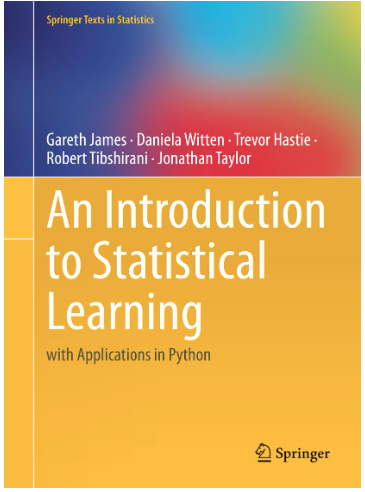
Description
An Introduction to Statistical Learning provides an accessible overview of the field of statistical learning, an essential toolset for making sense of the vast and complex data sets that have emerged in fields ranging from biology to finance, marketing, and astrophysics in the past twenty years. This book presents some of the most important modeling and prediction techniques, along with relevant applications. Topics include linear regression, classification, resampling methods, shrinkage approaches, tree-based methods, support vector machines, clustering, deep learning, survival analysis, multiple testing, and more. Color graphics and real-world examples are used to illustrate the methods presented. This book is targeted at statisticians and non-statisticians alike, who wish to use cutting-edge statistical learning techniques to analyze their data.
Four of the authors co-wrote An Introduction to Statistical Learning, With Applications in R(ISLR), which has become a mainstay of undergraduate and graduate classrooms worldwide, as well as an important reference book for data scientists. One of the keys to its success was that each chapter contains a tutorial on implementing the analyses and methods presented in the R scientific computing environment. However, in recent years Python has become a popular language for data science, and there has been increasing demand for a Python-based alternative to ISLR. Hence, this book (ISLP) covers the same materials as ISLR but with labs implemented in Python. These labs will be useful both for Python novices, as well as experienced users.
When it’s especially worth buying
You’ll get real value if you want to:
- become a data scientist or ML engineer
- understand ML beyond “import model, fit, predict”
- prepare for interviews where theory matters
- build solid foundations before deep learning
Reviews
There are no reviews yet.