
Do My Microsoft Excel Homework: The Complete Guide to Formulas, Shortcuts, and Features
Will you do my Excel homework for me? Yes, We will guide you through on how to do your Excel homework. We will start off by Explaining what Excel is. It’s a spreadsheet application that organizes data into rows and columns, letting users calculate, analyze, and visualize information without writing code.
Microsoft Excel remains the world’s most widely used spreadsheet software, powering everything from classroom assignments to million-dollar financial models. Whether you’re a student building your first gradebook or a professional automating a monthly report, mastering Excel is one of the highest-leverage skills you can learn.
We will take you through everything you need to do your Excel homework and all that it takes to get productive in Excel — the interface, must-know formulas, time-saving shortcuts, and the features that separate casual users from power users.
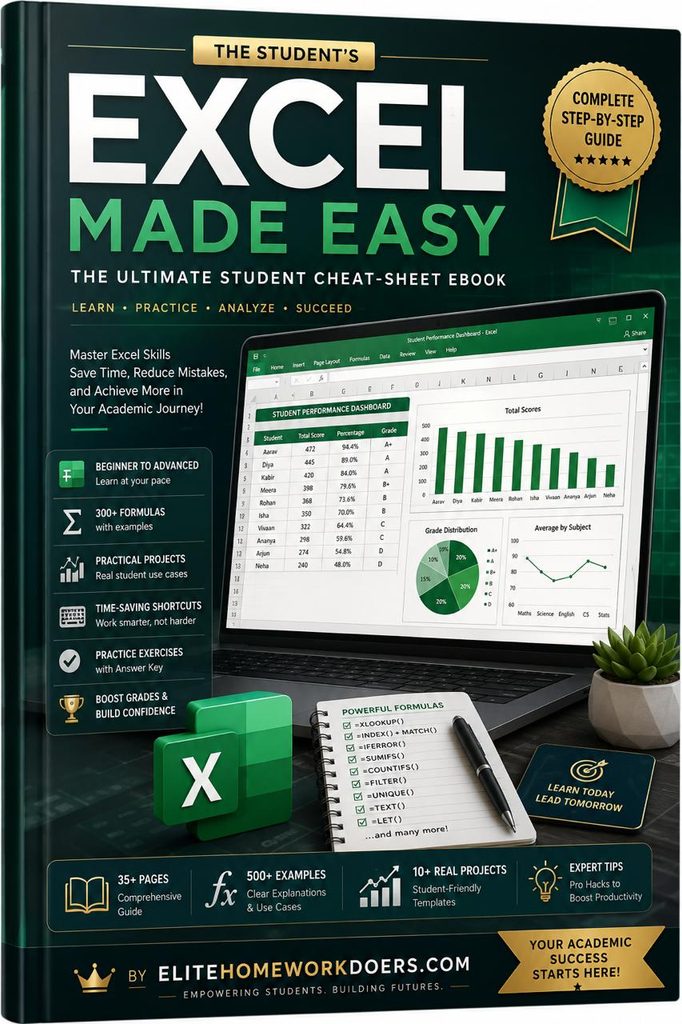
Whos is this free excel eBook for? Perfect for anyone looking to level up their spreadsheet skills. From basic formulas to hidden shortcuts. Boost productivity with expert tips for beginners and pros alike.
Struggling with Excel homework? This student-focused guide breaks down formulas, shortcuts, and PivotTables into steps you’ll actually remember. In case you are new to Excel, we will guide you through and help you learn what it is, how it works, and why it’s the go-to tool for data, budgeting, and analysis across nearly every industry.
Why Should I Pay Someone To Do My Excel Homework For Me
It’s cheap practice for a skill that’s expensive to learn under pressure.
Nobody wants to be figuring out VLOOKUP for the first time during a finance internship with a manager watching. Homework is the low-stakes version of that same problem.
Formulas build on each other.
SUMIFS is just IF plus SUM. PivotTables assume you already get how ranges work. Skipping the “boring” homework now tends to make the next thing feel harder than it needs to, not easier.
You’re the one who has to use the skill later.
Excel shows up constantly outside that one assignment — budgeting, a part-time job, a future internship, grad school data. The assignment is annoying; the skill underneath it isn’t optional if you’re heading into almost any office job, research role, or even just managing your own money well.
It’s genuinely one of the faster skills to get good at
Unlike a lot of coursework, Excel fluency compounds fast a weekend of real practice with 10-15 formulas covers most of what you’ll ever need, so the payoff-to-effort ratio is unusually good.
That said, if the actual issue is that you’re stuck, bored, or need someone to pay to do your Excel homework, we are here to guide you through and overcome the pressure that comes with a lot of Excel coursework
You Get To Learn Skills That Transfer Beyond School
Our Excel homework doer have the logical thinking behind a spreadsheet organizing data, writing conditional rules, summarizing results in the same thinking used in data analysis, finance. So guiding you through Learning it now means one less thing to learn on the job later.
Is this a trusted and reliable website to do my Excel homework for me? This is a question probably running through your mind. Yes, we are100% reliable. As a matter of fact we have vetted and verified Excel specialist that will do your Excel homework perfectly. .
Excel shows up far more often in student life than most people expect.
You Get To Learn Common Business Use Cases
- Financial modeling and budgeting — forecasts, expense trackers, loan calculators
- Reporting and dashboards — PivotTables and charts that turn raw numbers into insight
- Project tracking — timelines, task lists, and resource planning
- Inventory and operations — stock levels, order tracking, logistics data
You Get To Learn Common Academic and Personal Use Cases
- Grade calculations and weighted averages
- Lab data and research statistics
- Personal budgeting and expense tracking
- Group project planning and shared to-do lists
Because it’s flexible enough for almost any numeric task, Excel shows up in nearly every industry — finance, healthcare, education, retail, and logistics among them.
Excel’s learning curve is gentler than it looks a handful of formulas, a few keyboard shortcuts, and an understanding of PivotTables cover most real-world use cases. Building fluency here pays off well beyond the spreadsheet, since the same logical thinking transfers directly to data analysis, budgeting, and reporting in any field.
What is Excel Used for?
- Grade tracking — calculating averages, weighted scores, and GPA
- Budgeting — tuition, rent, meal plans, and part-time income
- Lab and research data — statistics, charts, and data cleanup for reports
- Group projects — shared trackers, task lists, and budgets
- Internship and job prep — Excel fluency is a common resume requirement
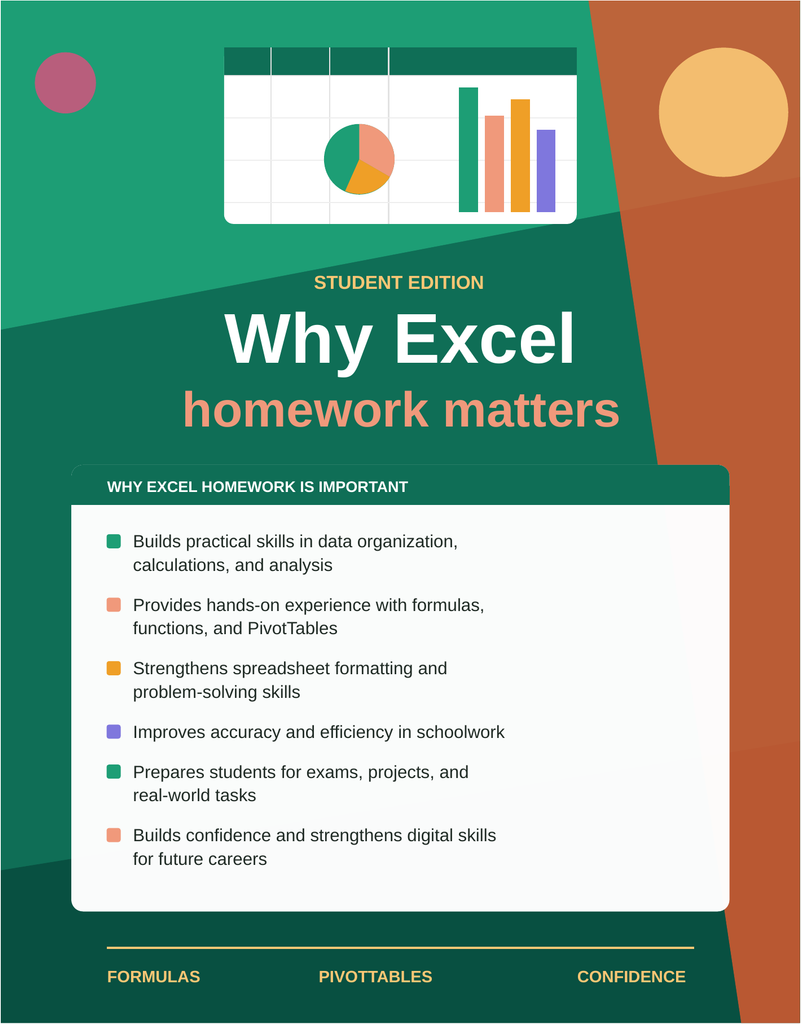
How Will You Guide Me Do My Excel Homework?
We will start by explaining what Excel is Before diving into formulas, it helps to know the basic vocabulary.
Excel Key Vocabulary
- Workbook — the entire file you save (a .xlsx document)
- Worksheet — a single tab within the workbook
- Cell — one box in the grid, identified by its column and row (e.g., B4)
- Range — a rectangle of cells, written as B4:D9
The Ribbon and Toolbar
- Ribbon — the tabbed toolbar across the top (Home, Insert, Formulas, Data)
- Quick Access Toolbar — a small customizable row above the Ribbon for your most-used commands
- Formula bar — shows the actual content or formula behind the active cell
- Name Box — top-left field showing (or letting you jump to) the active cell address
What a Cell Can Hold
Every cell can hold one of three things: text, a number, or a formula (which always starts with =).
Essential Excel Formulas Every User Should Know
Formulas are where Excel earns its reputation as an analysis powerhouse. Here are the core categories worth learning first.
Math and Statistics Formulas
- =SUM(A1:A10) — adds a range of numbers
- =AVERAGE(A1:A10) — calculates the mean
- =COUNT(A1:A10) — counts numeric cells
- =MIN(A1:A10) / =MAX(A1:A10) — smallest and largest values
- =ROUND(A1, 2) — rounds to a set number of decimal places
Excel Logic Formulas
- =IF(A1>=60, “Pass”, “Fail”) — returns one value or another based on a condition
- =IFERROR(A1/B1, “Check input”) — shows a custom message instead of an error
- =AND(A1>60, B1<100) / =OR(A1>90, B1=”Bonus”) — combine multiple conditions
Excel Lookup Formulas
- =VLOOKUP(D2, A:C, 3, FALSE) — the classic function for finding matching data
- =XLOOKUP(D2, A:A, B:B) — the modern, more flexible replacement for VLOOKUP
- =INDEX(C:C, MATCH(D2, A:A, 0)) — a flexible combo that can look in any direction
Excel Multi-Criteria Formulas
- =SUMIFS(C:C, A:A, “Math”, B:B, “>80”) — sums a range based on multiple conditions
- =COUNTIFS(A:A, “Math”, B:B, “>80”) — counts rows matching multiple conditions
- =AVERAGEIFS(C:C, A:A, “Math”, B:B, “>80”) — averages a range based on multiple conditions
Excel Text Formulas
- =CONCAT(A1, ” “, B1) — joins text from multiple cells
- =TRIM(A1) — removes extra spaces
- =LEFT(A1, 3) / =RIGHT(A1, 3) — pulls characters from the start or end of text
Learning these formulas alone covers a large share of everyday spreadsheet work. Excel Keyboard Shortcuts That Save Time Speed in Excel comes from the keyboard, not the mouse.
Editing and Navigation Shortcuts
| Shortcut | Action |
| Ctrl + C / V / X | Copy / Paste / Cut |
| Ctrl + Arrow key | Jump to the edge of a block of data |
| Ctrl + Page Up/Down | Move between sheet tabs |
| F2 | Edit the active cell |
Formatting and Formula Shortcuts
| Shortcut | Action |
| Ctrl + T | Convert a range into a formatted Table |
| Ctrl + ; | Insert today’s date |
| Ctrl + 1 | Open the Format Cells dialog |
| Alt + = | AutoSum the selected range |
| F4 | Toggle $ locking in a formula reference |
| `Ctrl + “ | Show formulas instead of results |
These shortcuts reduce repetitive clicking and make it easier to work through large spreadsheets without losing your place.
Do My Excel PivotTables Homework For Me
Do you need someone to do your Excel PivotTable homework? We will do it for you. A PivotTable summarizes hundreds or millions of rows into a compact, readable table without writing a single formula.
How to Build a PivotTable in 4 Steps
- Click anywhere inside your data, then go to Insert → PivotTable.
- Drag a category field (like “Region”) into the Rows area.
- Drag a numeric field (like “Revenue”) into the Values area.
- Adjust the summary type (Sum, Average, Count) as needed.
When to Use a PivotTable
PivotTables are the fastest way to go from raw data to a clear answer use them any time you need a summary broken down by category, without writing SUMIFS formulas by hand.
Do My Charts and Data Visualization Excel Homework For Me
Charts and Data Visualization homework has numbers that are easier to understand as pictures. We understand this
Choosing the Right Chart Type
- Line charts — trends over time
- Bar/column charts — comparisons across categories
- Pie charts — parts of a whole (best with six or fewer slices)
Building a Chart Quickly
Select your data, go to Insert → Recommended Charts, and Excel will suggest the chart type that fits your data best. Click the + icon beside any chart to add titles, labels, or gridlines.
Common Excel Errors and What They Mean
| Error | Cause |
| #DIV/0! | Dividing by zero or an empty cell |
| #N/A | A lookup formula found no match |
| #REF! | A cell the formula pointed to was deleted |
| #VALUE! | Wrong data type, like text where a number is expected |
| ##### | Column too narrow to display the value |
How to Fix Excel Errors Faster
Click the small warning triangle next to an error cell — Excel usually offers a plain-language explanation and a one-click fix.
Tips to Help Me Do My Excel Homework
Habits That Build Fluency
- Practice with real data rather than tutorials alone — apply formulas to your own budget, grades, or hobby data.
- Learn one formula category at a time instead of trying to memorize everything at once.
- Use `Ctrl + “ regularly to check that formulas reference the cells you intend.
Tools That Save Time Long-Term
- Convert ranges to Tables (Ctrl + T) so formulas and formatting extend automatically as data grows.
- Use named ranges instead of raw cell references for constants like tax rates.
- Freeze header rows on long sheets so column labels stay visible while scrolling.

Who Will Do My Excel Homework For Me
Whether you’re building your first spreadsheet or tackling complex formulas, having the right guide makes all the difference.
Our well designed do my Excel homework for me service have step-by-step tutorials, practical examples, and expert tips designed to meet you exactly where you are — no jargon, no overwhelm, just clear explanations you can actually use. From simple functions like SUM and VLOOKUP to advanced tools like pivot tables and macros, you’ll get hands-on guidance every step of the way
FAQS
Common Questions Students Ask About Excel
Quick answers to questions you might have.
The basics — entering data, simple formulas, and formatting — can be learned in a few hours. Advanced features like PivotTables and dynamic arrays take longer but build naturally on the fundamentals.
Most courses take 4-12 weeks. But you can go at your own speed – faster or slower depending on your schedule.
SUM, IF, and VLOOKUP/XLOOKUP are used most often across finance, data analysis, and everyday tasks, making them the highest-priority formulas to learn first.
Yes. Despite the rise of specialized data tools, Excel remains a standard for quick analysis, reporting, and collaboration across nearly every industry.
XLOOKUP is a newer function that searches in any direction and handles missing matches more gracefully, while VLOOKUP only searches left-to-right and requires an exact-match flag.