
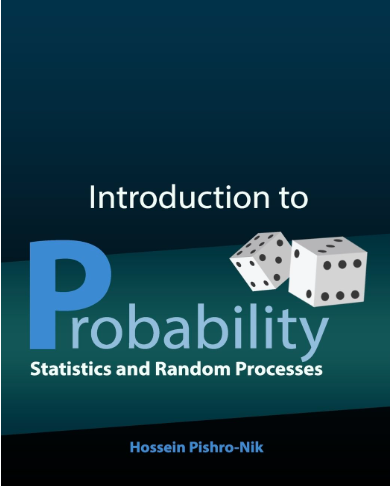
Description
Introduction to Probability, Statistics, and Random Processes
Introduction to Probability, Statistics, and Random Processes by Hossein Pishro-Nik is a widely used undergraduate-level textbook that introduces probability theory, statistics, and stochastic (random) processes in a single volume. It was published in 2014 by Kappa Research and is approximately 730–750 pages long. (Open Library)
What the book covers
The text progresses from foundational probability to more advanced topics: (Google Books)
- Probability fundamentals
- Sample spaces and events
- Probability axioms
- Conditional probability
- Bayes’ theorem
- Counting techniques
- Random variables
- Discrete and continuous distributions
- Expectation and variance
- Moment-generating functions
- Joint distributions and random vectors
- Limit theorems
- Laws of large numbers
- Central limit theorem
- Convergence concepts
- Statistics
- Estimation
- Hypothesis testing
- Bayesian and classical approaches
- Random processes
- Poisson processes
- Markov chains
- Brownian motion
- Random signal processing
- Simulation
- Monte Carlo methods
- Random number generation
- Examples using MATLAB and R (with some online materials including Python) (Bookshop.org)
Strengths
- Clear, intuitive explanations with many worked examples.
- Covers probability, statistics, and stochastic processes in one coherent text.
- Includes a large number of solved exercises.
- Frequently recommended for self-study by students and practitioners. (Bookshop.org)
Mathematical prerequisites
A solid background in:
- Calculus (especially integration)
- Basic algebra
- Some familiarity with mathematical reasoning
Students without calculus can still benefit from the early chapters, but later sections become significantly easier with calculus knowledge. (Reddit)
Who should read it?
This book is a good choice if you are:
- Studying engineering, computer science, data science, mathematics, economics, or finance.
- Preparing for machine learning, AI, communications, or stochastic modeling.
- Looking for a bridge between introductory statistics and more advanced probability theory.
Compared with other popular books
| Book | Style | Level |
|---|---|---|
| Introduction to Probability, Statistics, and Random Processes | Balanced, applied + theoretical | Beginner to intermediate |
| Introduction to Probability | Conceptual, problem-solving focused | Intermediate |
| A First Course in Probability | Traditional probability theory | Intermediate |
| All of Statistics | Fast-paced statistics overview | Intermediate to advanced |
If you’re studying probability and statistics for machine learning, data science, or engineering, this is often considered one of the strongest free/self-study resources available. (Reddit)
If you’d like, I can also provide a chapter-by-chapter study plan for this book or explain any chapter in detail.
Reviews
There are no reviews yet.